KPG 193 Test System
The KPG 193 (Korean Power Grid 193-bus) is a synthetic test system representing the Korean power grid, developed exclusively from open-source data to support power system research and decarbonization studies. This test system captures Korea's unique characteristics: generation mix, renewable penetration, concentrated urban demand, and isolated grid structure.
Background
The KPG 193 is an open Korean grid test system built entirely from publicly available sources, as detailed in:
Geonho Song and Jip Kim, "KPG 193: A Synthetic Korean Power Grid Test System for Decarbonization Studies," arXiv preprint arXiv:2411.14756, 2024.
Available at: https://arxiv.org/abs/2411.14756v2
The methodology involved:
Data collection from OpenStreetMap, KEPCO, KPX and municipal-level statistics
Spatial clustering based on KEPCO regional office locations to abstract sensitive details
Data processing including parameter for generators and transmission lines, and renewable generation profiles
Validation through Unit Commitment and AC Optimal Power Flow studies over 8760 hours
System Characteristics
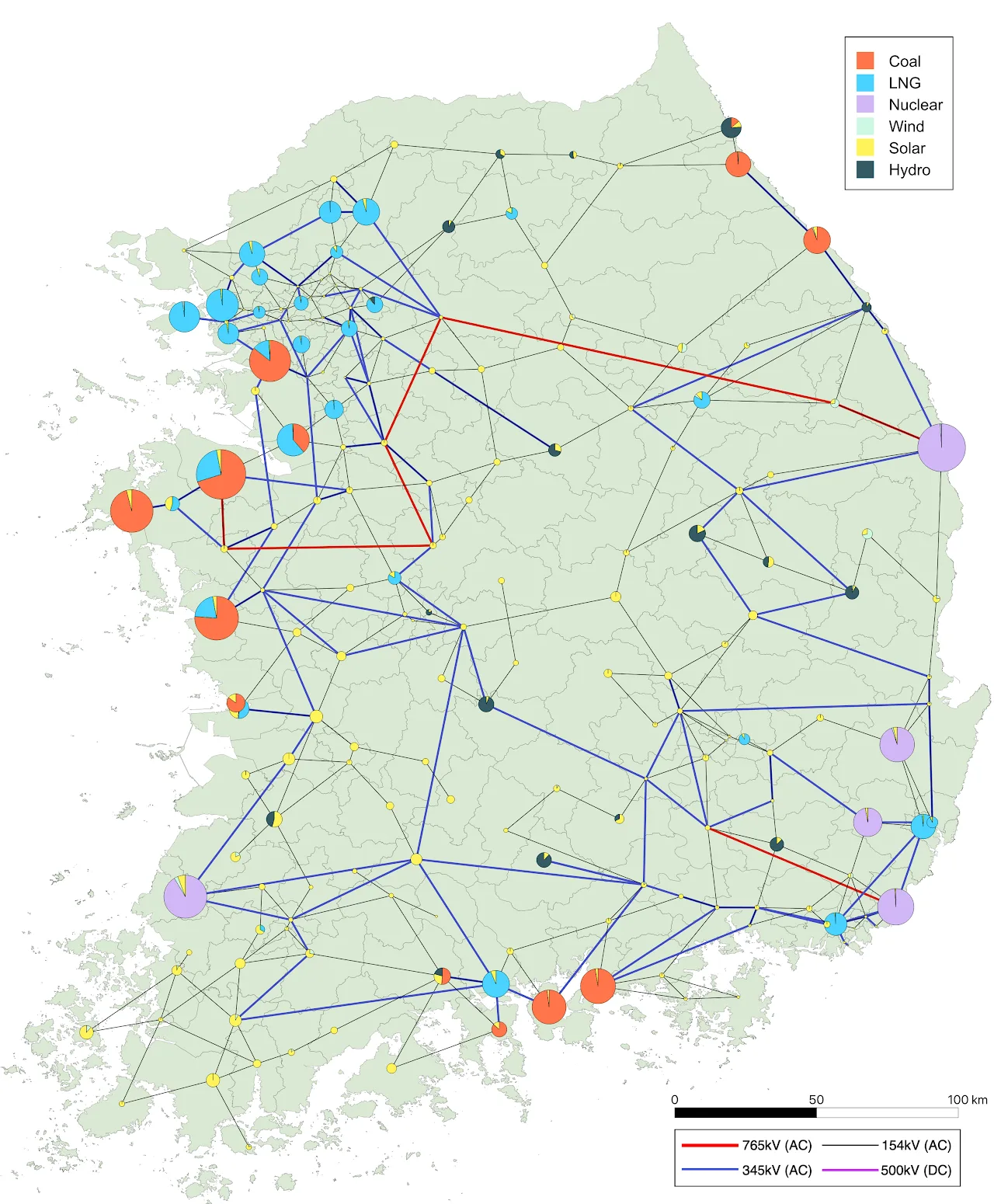
Component | Count (2025) | Description |
|---|---|---|
Buses | 193 | Network nodes representing substations and load centers |
Generators | 201 | Thermal units (Coal, LNG, Nuclear) |
Transmission Lines | 746 | AC transmission lines across voltage levels |
DC Lines | 2 | 500kV HVDC connection |
Voltage Levels | 4 | 765 kV (AC), 345 kV (AC), 154 kV (AC), and 500kV (DC) |
Geographic Areas | 5 | Regional divisions matching Korean grid structure |
Temporal Coverage
Full year simulation: 365 days of hourly data (8,760 hours)
Demand profiles: Hourly load for all 193 buses
Renewable generation: Hourly output ratios for solar, wind, hydro, and pumped storage
Weather data: Meteorological data(longwave flux, temperature, wind speed) from LDAPS
Reference solutions: Pre-computed commitment decisions for operation studies
Data Structure
The KPG 193 test system provides a comprehensive framework for simulating the Korean power grid with all necessary data for optimization studies.
flowchart TB
subgraph "KPG 193 Test System"
A[Network Files MATPOWER format + Geographic data]
B[Renewable Capacity Solar, Wind, Hydro by bus]
C[Nuclear Must-Off Planned outages maintenance schedules]
D[Temporal Profiles 365 days × 24 hours Demand, Weather, Renewables]
end
A --> F[Power System Optimization]
B --> F
C --> F
D --> F
The kpg193_v2_0_0/ directory contains all data files organized by category:
kpg193_v2_0_0_<year>/
├── network/
│   ├── m/
│   │   └── kpg193_v2_0_0_<year>.m           # MATPOWER v2 case file
│   ├── mat/
│   │   └── kpg193_v2_0_0_<year>.mat         # MATLAB MAT file
│   └── metadata/
│       ├── bus_metadata/
│       │   └── bus_metadata_<year>.csv       # Bus coordinates, names, voltage, area, and shunts
│       ├── line_metadata/
│       │   └── line_metadata_<year>.csv      # Line connections, parameters, and ratings
│       ├── generator_metadata/
│       │   └── generator_metadata_<year>.csv # Conventional generator specifications and costs
│       └── hydropower_metadata/
│           ├── hydropower_unit_metadata_<year>.csv
│           │                                 # Hydro and pumped-storage unit specifications
│           └── hydropower_group_metadata_<year>.csv
│                                             # Group composition, capacity, and storage limits
├── renewables_capacity/
│   ├── wind_generators_<year>.csv            # Wind capacity by bus
│   ├── solar_generators_<year>.csv           # Solar capacity by bus
│   └── hydropower_generators_<year>.csv      # Hydro and pumped-storage capacity by bus
├── constraints/
│   └── hydropower_group_energy_constraints_<year>.csv
│                                             # Daily group generation energy limits (MWh)
├── mustoff/
│   └── mustoff.csv                           # Generator must-off schedules
└── profile/
    ├── demand/
    │   └── demand_<day>.csv                   # Hourly active and reactive demand per bus
    ├── commitment_decision/
    │   └── commitment_decision_<day>.csv      # Hourly conventional and pumped-storage unit status
    ├── renewables/
    │   └── renewables_<day>.csv               # Hourly solar, wind, hydro, and pumped-storage ratios per bus
    └── weather/
        └── weather_<day>.csv                  # Hourly radiation, temperature, and wind data per bus
Version History
Version | Updated | Major Changes |
|---|---|---|
v2.0 | 2026-10 | Annual datasets for 2022–2025. Updated to total system demand and realistic generator capacities |
v1.5 | 2025-12 | Generator locations corrected |
v1.4 | 2025-09 | Bus numbering standardized, improved clustering |
v1.3 | 2025-07 | Renewable generation profiles fixed |
v1.2 | 2025-02 | Updated generator costs/capacities |
v1.1 | 2024-12 | Changed slack bus (bus 1 → bus 52) |
v1.0 | 2024-11 | Initial public release |
Citation
If you use the KPG 193 test system in your research, please cite:
@article{song2024kpg193,
  title={KPG 193: A Synthetic Korean Power Grid Test System for Decarbonization Studies},
  author={Song, Geonho and Kim, Jip},
  journal={arXiv preprint arXiv:2411.14756},
  year={2024}
}
LICENSE
The test system is made available under the Open Database License (ODbL 1.0).
External Resources
Research Paper: arXiv:2411.14756
Dataset Download: github.com/agm-center/kpg-testgrid
MATPOWER: MATPOWER User's Manual
OpenStreetMap: Data source for network topology