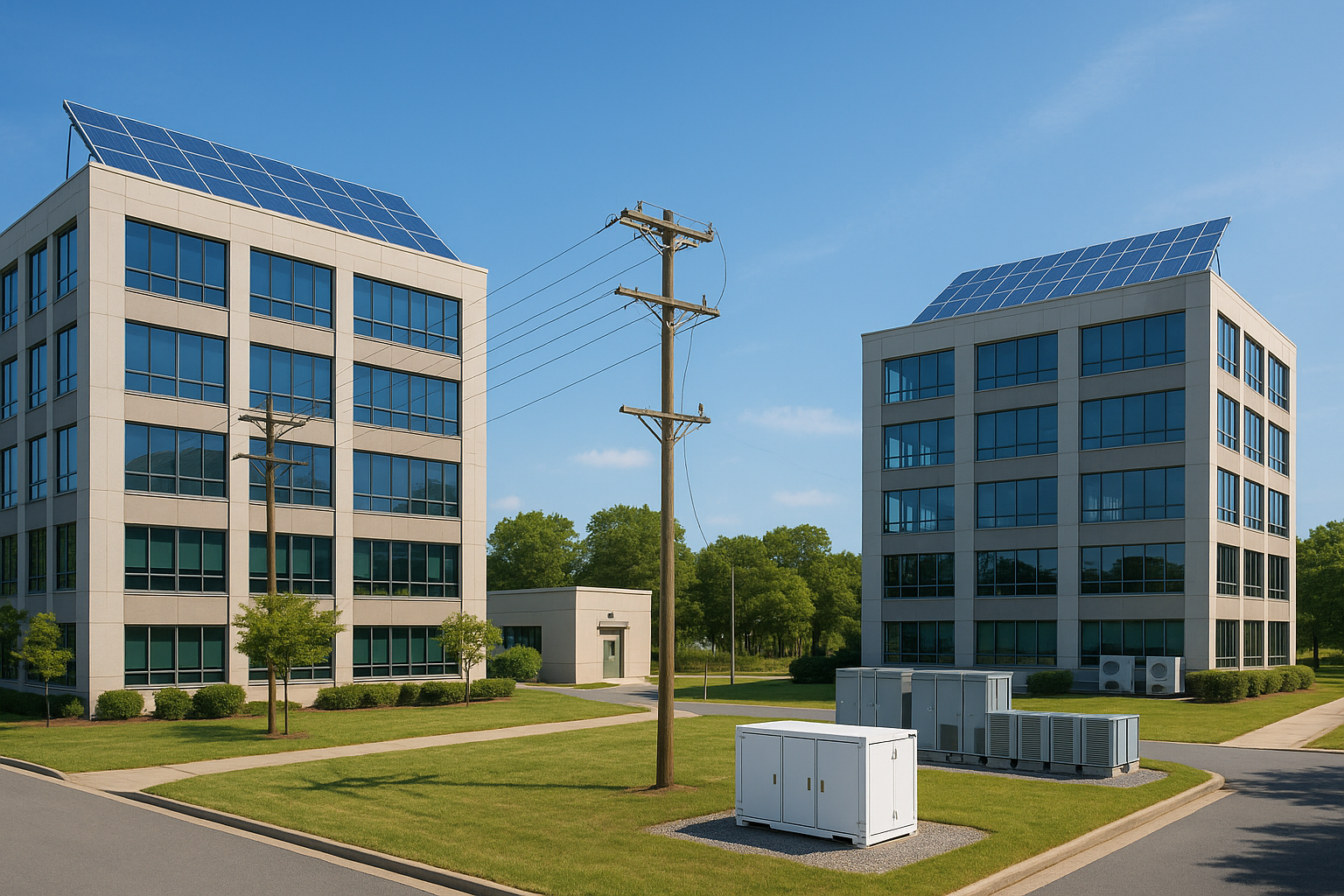
Community Energy Management System for Fast Frequency Response
How multiple buildings can work together to provide fast frequency response while minimizing energy costs and maintaining comfort.
🏙️ Community Energy Management for Fast Frequency Response
A practical explanation of how buildings can collaborate to support grid stability.
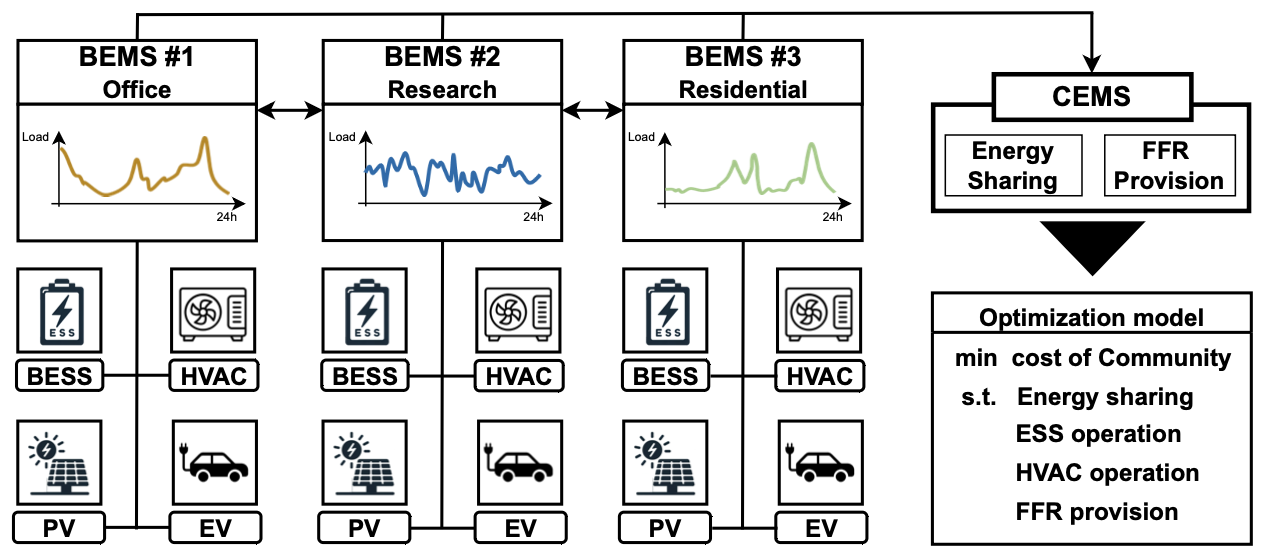
Figure 1. Community Energy Management System
As renewable energy grows, power systems lose traditional sources of inertia (like synchronous generators).
This makes the grid more sensitive to sudden frequency changes, especially after disturbances.
Fast Frequency Response (FFR) — action within seconds or sub-seconds — becomes essential.
Individual buildings with DERs (ESS, HVAC, PV, EV chargers) can help,
but no single building is large or flexible enough to deliver reliable system-level FFR.
This research introduces a Community Energy Management System (CEMS):
a coordinated way for multiple buildings to act together as one flexible resource.
🧩 Why a Community Approach Works Better Than Individual BEMS
A community typically includes diverse building types:
- Office (predictable daytime load)
- Research (equipment-heavy usage)
- Residential (evening peaks)
Each building has different DER strengths:
- ESS can deliver quick FFR
- HVAC can provide large reserves through temperature control
- PV reduces net load but is uncertain
- EV charging adds controllable demand
Individually, each building has limited flexibility.
Together, they can:
- share energy
- shift loads
- coordinate DER schedules
- jointly deliver a meaningful amount of FFR
This is exactly what CEMS enables.
🧠 Three-Level Hierarchical Control
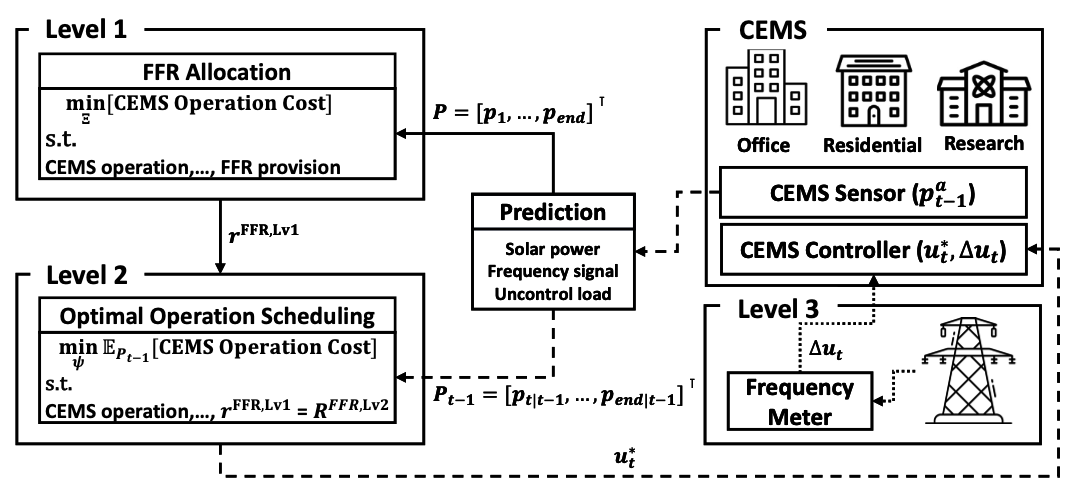
Figure 2. Three-level hierarchical control system for community EMS.
CEMS splits decision-making into three intuitive layers:
1️⃣ Level 1 — Day-Ahead Planning
The community estimates:
- tomorrow’s PV output
- building loads
- available DER flexibility
Using this, it sets:
- how much total FFR the community will offer
- baseline charging/discharging schedules
Level 1 focuses on cost and comfort, not speed.
2️⃣ Level 2 — Real-Time Scheduling (every hour)
Level 2 uses stochastic MPC (SMPC) to update DER schedules hourly based on the latest PV forecasts to deal with uncertainty.
It ensures:
- comfort remains within bounds
- ESS stays ready for FFR
- HVAC maintains flexibility
- Level 1 FFR commitments remain achievable
This layer is all about handling uncertainty smartly.
3️⃣ Level 3 — Fast Frequency Response (sub-second)
When frequency drops suddenly, Level 3 reacts immediately:
- ESS injects power
- HVAC adjusts compressor loads
- Optional EV load reductions occur
This response uses pre-allocated up/down FFR reserves defined in Levels 1 and 2.
🔍 What Each DER Contributes
⚡ ESS
- Charges during low-cost hours
- Discharges during PV peaks
- Maintains mid-range SOC for fast FFR
- Can react instantly to frequency deviations
🌬 HVAC
- Uses building thermal inertia
- Adjusts temperature setpoints slightly to provide FFR
- Can contribute hundreds of kW without affecting comfort
☀️ PV
- Reduces daytime net load
- Introduces uncertainty that Level 2 must handle
🚗 EV Charging
- Flexible, controllable demand resource
📈 Key Results from the Case Study
The test system models a real campus consisting of Office, Research, and Residential buildings.
✔ 1. Energy cost reduced by 10%
Community-level coordination:
- shares excess PV
- smooths load peaks
- schedules ESS efficiently
CEMS outperforms isolated BEMS operation.
✔ 2. FFR capability increased by 24%
Coordinated scheduling allows:
- ESS to hold more reserve
- HVAC to contribute dynamically
- energy sharing to reduce conflicts
This leads to significantly higher FFR availability.
✔ 3. Occupant comfort remains stable
Despite aggressive DER control, CEMS keeps:
- indoor temperatures within 18–26℃
- comfort costs low
- HVAC adjustments nearly unnoticeable
This shows FFR does not require discomfort.
✔ 4. Hierarchical control handles uncertainty effectively
Level 2 (SMPC) ensures:
- resilience to PV fluctuations
- stable reserve allocation
- smooth DER transitions
The result is a community that behaves like a reliable grid asset.
💡 Why This Matters for the Future Grid
As grids become more renewable-heavy, system operators need fast, distributed resources.
Community-based FFR offers:
✔ a scalable alternative to traditional inertia
✔ new revenue opportunities for building operators
✔ lower energy bills through coordinated DER use
✔ a path toward smart campuses and smart cities
This work shows that FFR is not only for large generators—
communities of buildings can play a major role.
🔭 Future Extensions
- Coordinating EV users and building operators
- Community-level bidding in FFR markets
- Multi-community aggregation for regional services
- Joint optimization of energy cost + comfort + system stability
📘 Reference
Jung, J., Kim, H., Shin, H., & Kim, J. “Community Energy Management System for Fast Frequency Response: A Hierarchical Control Approach.” 2025 IEEE Power & Energy Society General Meeting. [link]