Step 02
Online Exhibition
Introduction
The KPG Online Exhibition presents practical examples of transparent and reproducible power-system analysis using the KPG Platform.
What This Exhibition Contains
The exhibition is organized around the three KPG modules:
KPG TestGrid: synthetic Korean grid data for research and decarbonization studies
KPG Run: optimization and simulation for ED, UC, DC-OPF, and AC-OPF
KPG View: spatial visualization of networks and simulation outputs
Who This Is For
Researchers and students learning power-system modeling
Engineers and analysts building reproducible workflows
Stakeholders evaluating practical open-grid applications
Showcase 1: System Behavior Snapshot
This showcase establishes the operating context used later in the LMP case.
1) Renewable Curtailment Context
We start from a high-renewable operating condition where transfer limits can trigger curtailment risk in the Honam area.
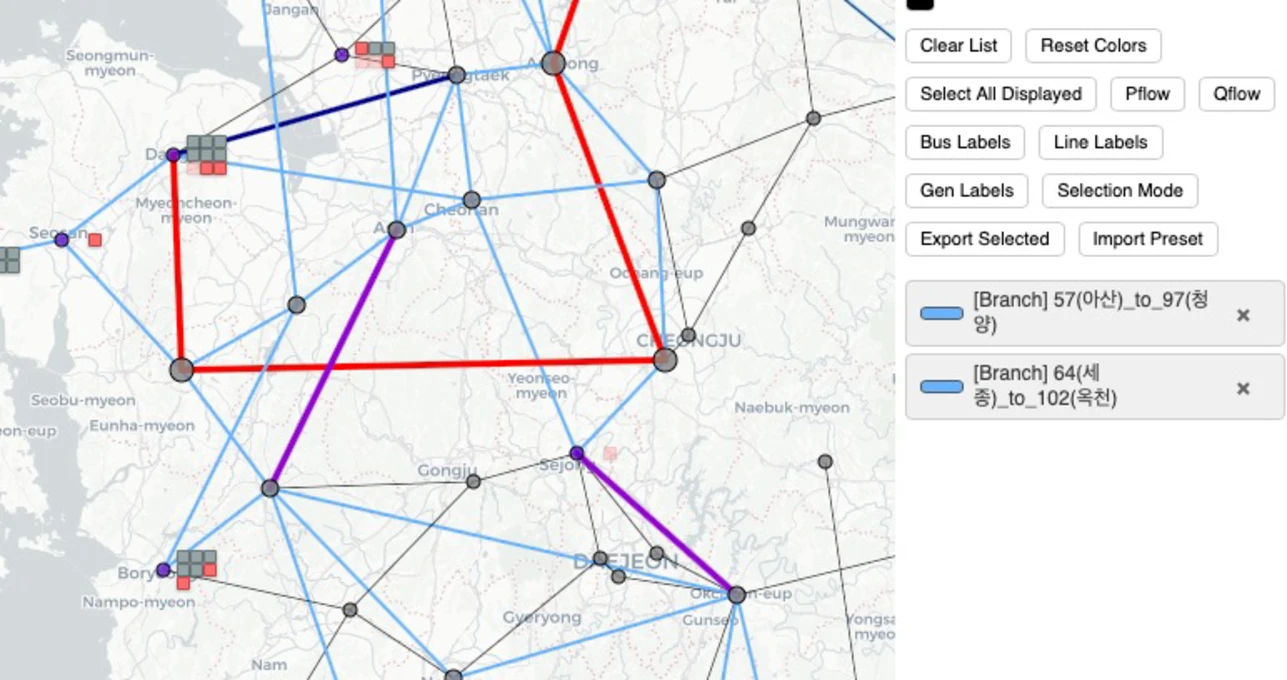
Honam-to-Chungcheong flowgate stability-limit context.
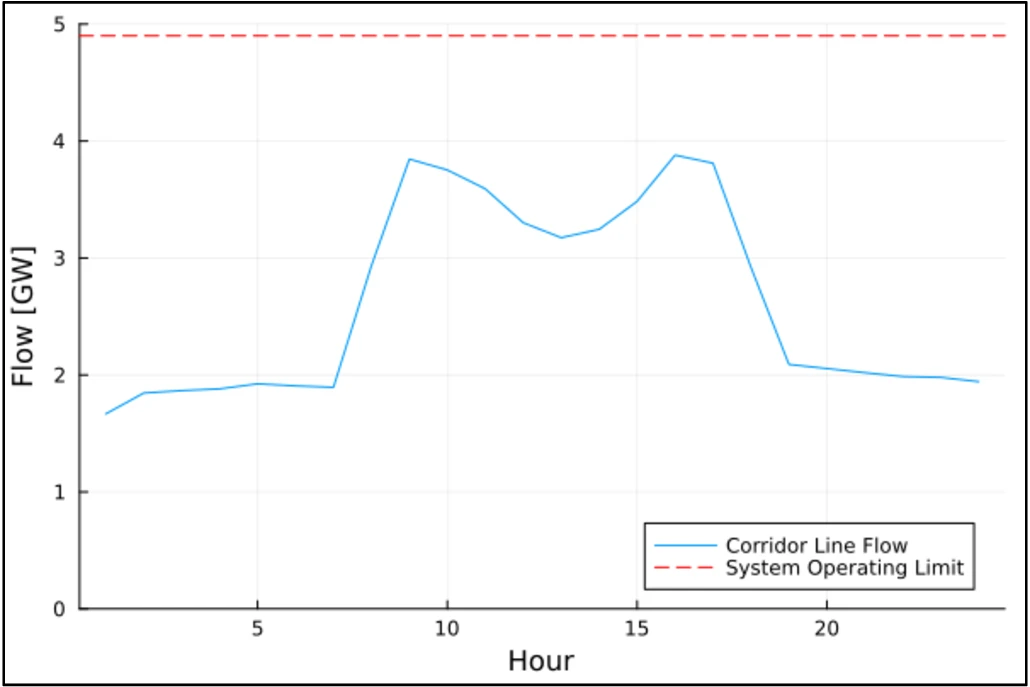
Flow result on the Honam-to-Chungcheong interface in KPG TestGrid.
The stability transfer limit of the Honam-to-Chungcheong flowgate is reported as 4.9 GW (Hooncheol Shin and Taeyong Song, “Analysis of the Impact of Solar Utilization on the Honam Power System,” 2024). To manage this limit, renewable generation in the Honam area is curtailed when northbound transfer stress becomes high.
KPG TestGrid is calibrated to 2022 conditions, so this limit is generally not reached even when renewable-driven northbound flow increases. However, as solar capacity expanded in 2023 and 2024, stability-related curtailment risk increased, and actual curtailment events have been observed since 2023.
2) Spring UC Behavior (Day 121)
Under low-load and high-renewable conditions (Day 121), thermal dispatch reduces during midday and recovers in evening hours.
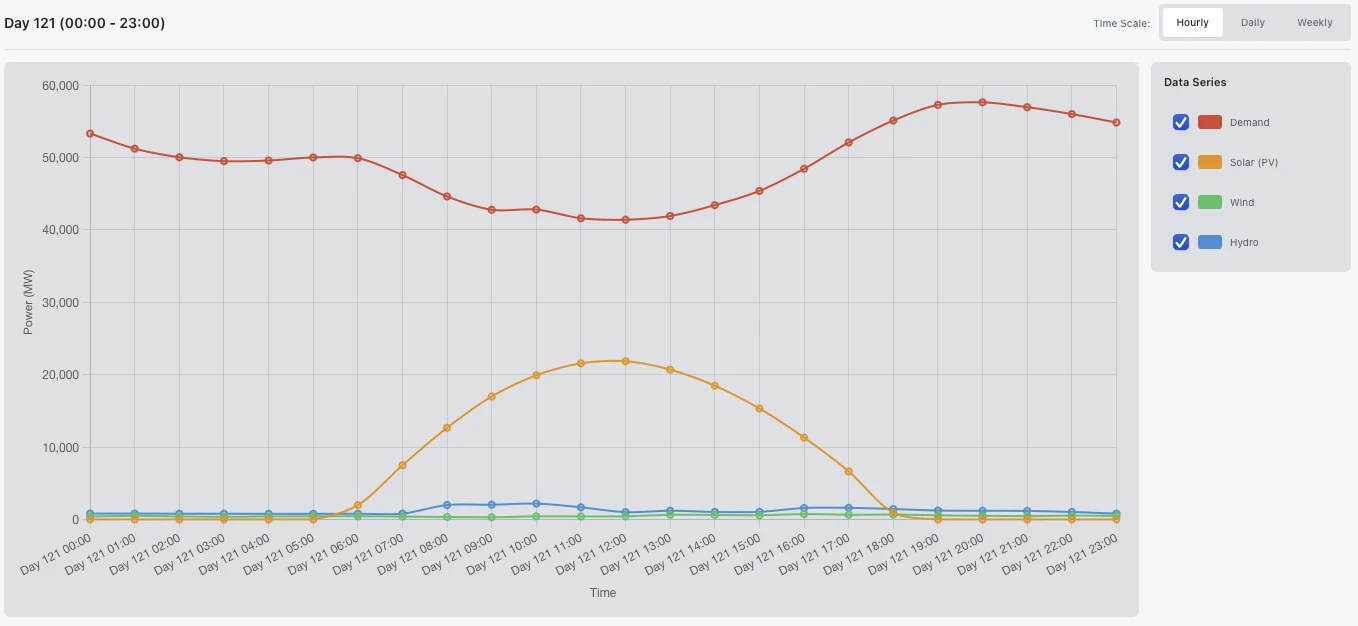
Representative spring-day profile (Day 121).
When system demand is low and solar generation is high, UC can decommit LNG units that normally serve peak demand.
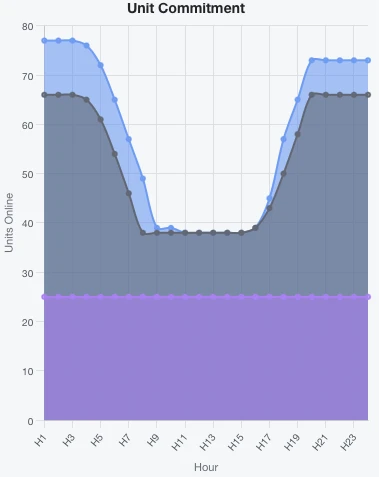
Day 121 UC dispatch result (hourly by resource).
Detailed snapshots (T=6, T=9, T=13, T=18) show this transition more concretely: as renewable output increases toward midday, LNG output is reduced or turned off, then restored as solar output declines.
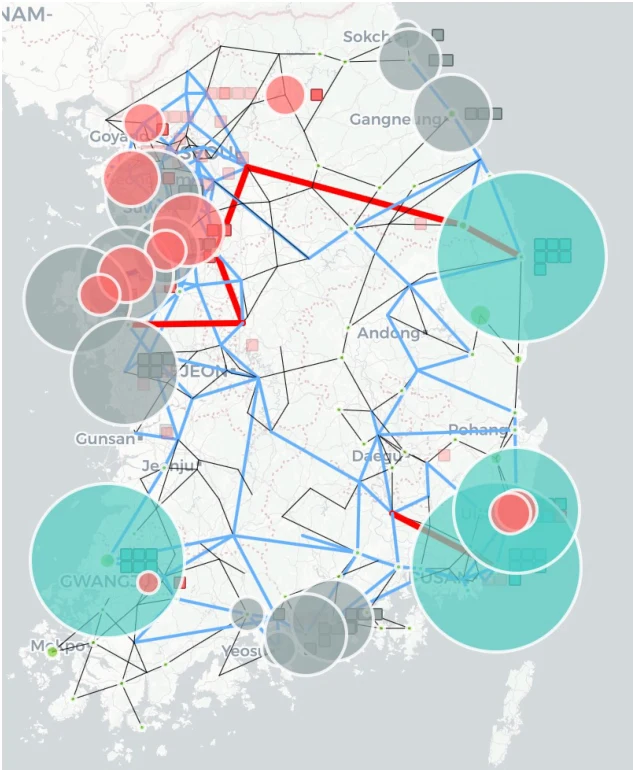
Snapshot at `T=6`.
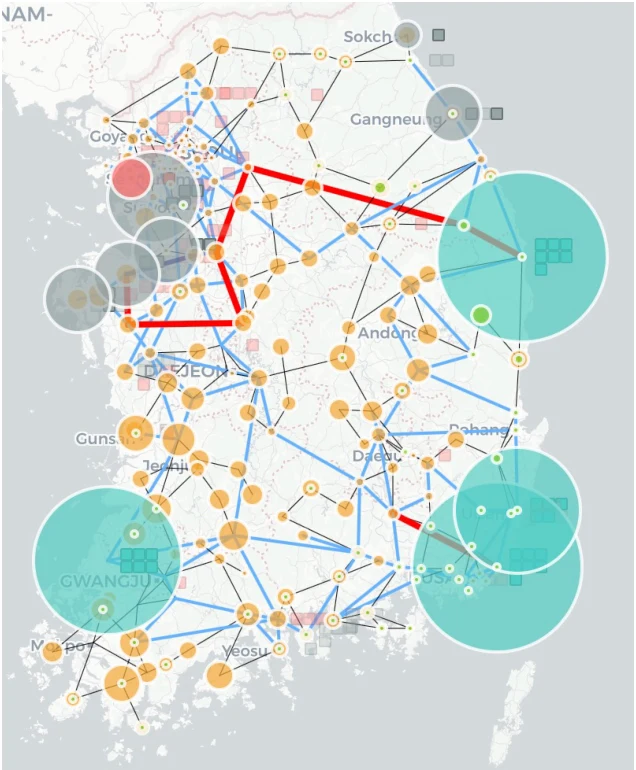
Snapshot at `T=9`.
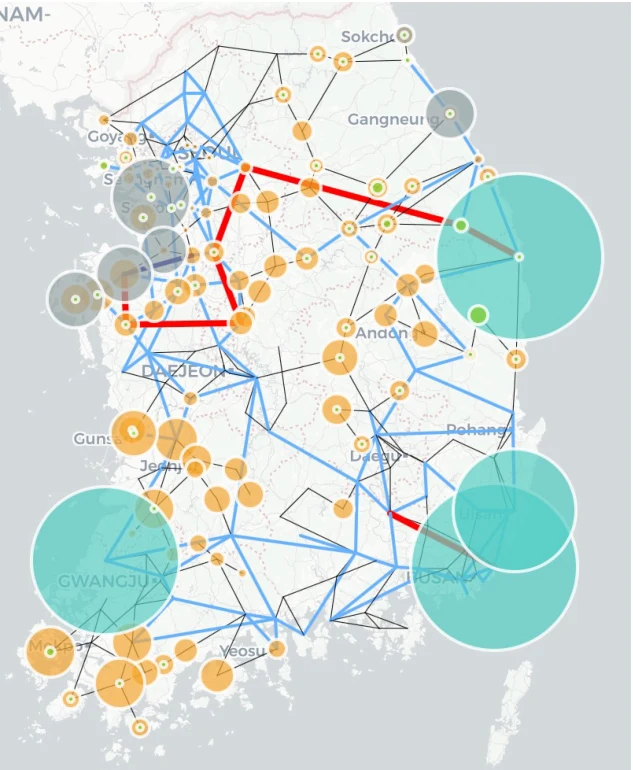
Snapshot at `T=13`.
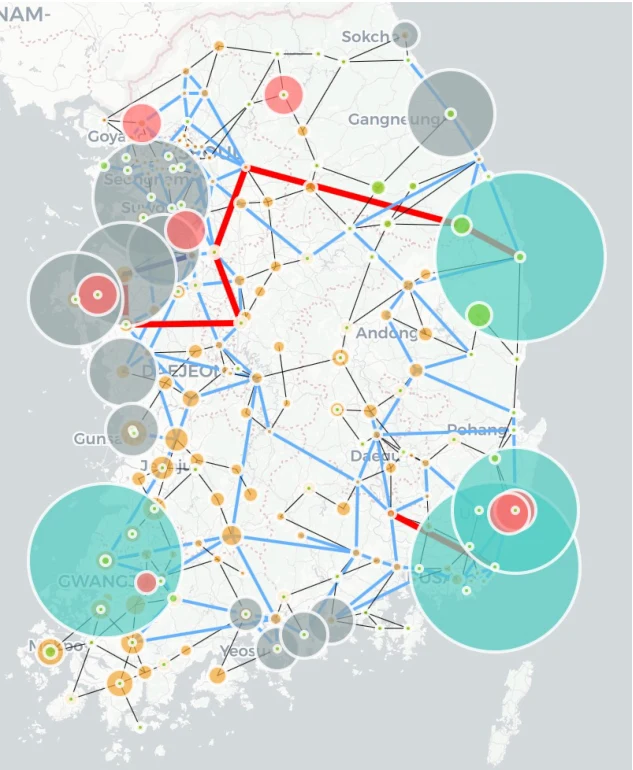
Snapshot at `T=18`.
Showcase 2: Locational Marginal Pricing (LMP)
Reproducible Codebase
Main repository: KPG Platform LMP Repository
Entry script:
calculate_lmp.jlCore modules:
src/Step4Lite.jl,src/runner.jl,src/network.jl,src/opf_math.jlIncluded dataset path:
data/KPG193_ver1_5Main output pattern:
outputs/ZonalResult_<output_name>_<day>_<hour>.csv
This section follows the public repository workflow and documents a runnable LMP case for KPG Platform users.
Why LMP Matters in This Case
Korean demand is heavily concentrated in the Seoul metropolitan area while a substantial share of generation is outside the region. This creates persistent transfer stress on key corridors, and nodal pricing is needed to explain location-specific marginal costs.
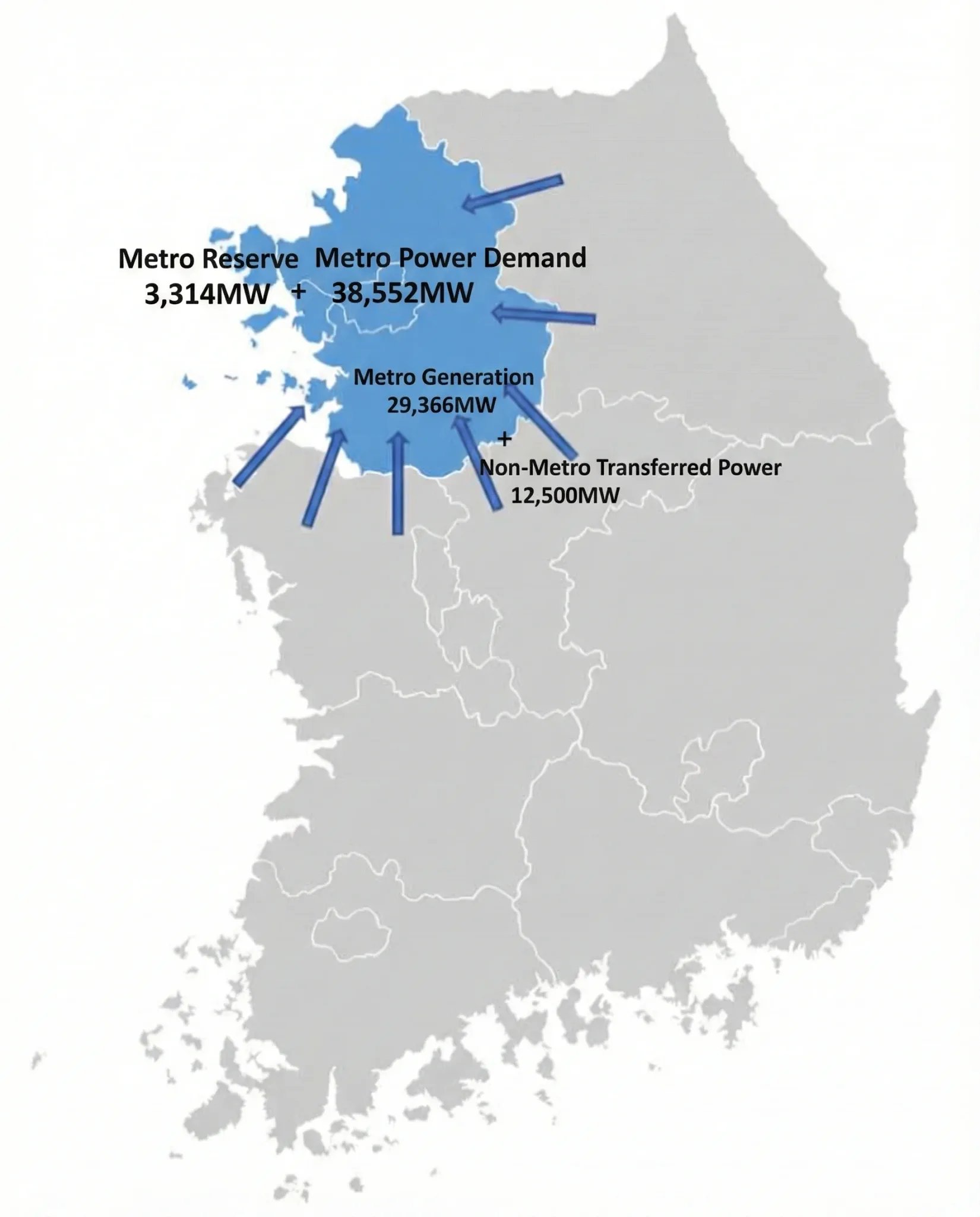
2023 Seoul Metropolitan Area supply and demand context.
LMP Definition and Decomposition
LMP at each bus is separated into energy, loss, and congestion components:
SMP is a single system-wide marginal value. LMP is node-specific and reflects network constraints directly, so regional price separation can be interpreted explicitly.
Reference: Detailed Explanation of SMP
Three-Stage Optimization in kpg-platform-lmp
M0: solves commitment and reserve with flow constraintsM1: updates loss model using loss-factor linearization based onM0M2: fixes commitment, re-solves dispatch, and computes final LMP decomposition from dual values
This M0 -> M1 -> M2 flow is implemented in src/runner.jl (run_step4) and is the exact workflow used for this exhibition.
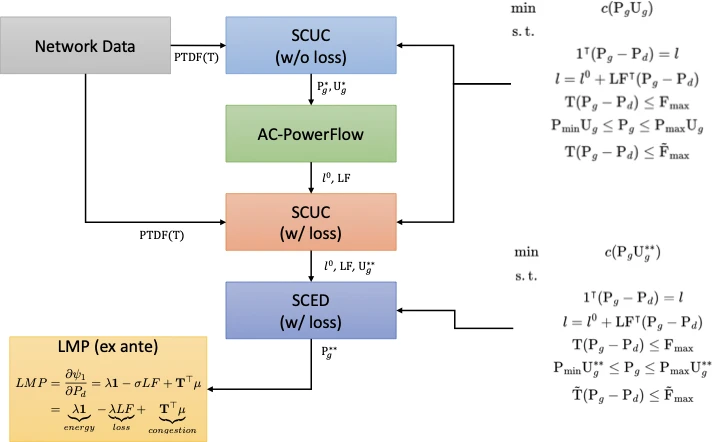
Day-ahead market stage and placement of the LMP case.
Default Case Configuration (from default_config)
Time index:
--day 188 --hour 18(KST)Solver:
Gurobidefault,HiGHSsupportedHVDC transfer: bus-index
53 -> 51,1.5 GWequivalent (15 pu, baseMVA100)Reserve requirements: up
4.5 GW, down1.2 GWFlowgate set (bindex pairs):
(28,80),(38,84),(44,57),(47,60),(50,54),(50,62)Cost override input:
input/kpg193_cost_lmp_backup.csvNetwork MAT input:
data/KPG193_ver1_5/network/mat/KPG193_ver1_5_LMP.mat
Generator fuel-cost localization input used in this case (partial excerpt):
|
|
|
|
|---|---|---|---|
|
|
|
|
|
|
|
|
|
|
|
|
|
|
|
|
|
|
|
|
|
|
|
|
|
|
|
|
|
|
|
|
|
|
|
|
|
|
|
|
|
|
|
|
Run the Case (Reproduction)
# Clone using the repository URL in "Main repository" above.
git clone <kpg-platform-lmp-repository-url>
cd kpg-platform-lmp

julia -e 'using Pkg; Pkg.add(["CSV","DataFrames","JuMP","MAT","HiGHS"])'
julia calculate_lmp.jl --solver HiGHS --day 188 --hour 18
Advanced run example (same option names as repository README):
julia calculate_lmp.jl \
  --day 188 \
  --hour 18 \
  --solver HiGHS \
  --data-dir data/KPG193_ver1_5 \
  --mat-path data/KPG193_ver1_5/network/mat/KPG193_ver1_5_LMP.mat \
  --cost-path input/kpg193_cost_lmp_backup.csv \
  --output-dir outputs \
  --output-name upreserve_45_dnreserve_12_step4
Output Schema and Validation
The generated CSV includes:
BusLMP,LMP_E,LMP_L,LMP_CLMP_C_FLOWGATElatitude,longitude(joined fromnetwork/location/bus_location.csv)
Validation checks:
Verify identity bus-by-bus:
LMP = LMP_E + LMP_L + LMP_CConfirm output filename exists:
outputs/ZonalResult_<output_name>_<day>_<hour>.csvPlot by
latitude/longitudefor a nodal map in KPG View or GIS tools
Reference Snapshot (Summer Peak, 18:00)
Metric | Reference value |
|---|---|
Nodal LMP range |
|
Energy component ( |
|
Loss component ( |
|
Congestion component ( |
|
HVDC operating point (Dangjin-Godeok) |
|
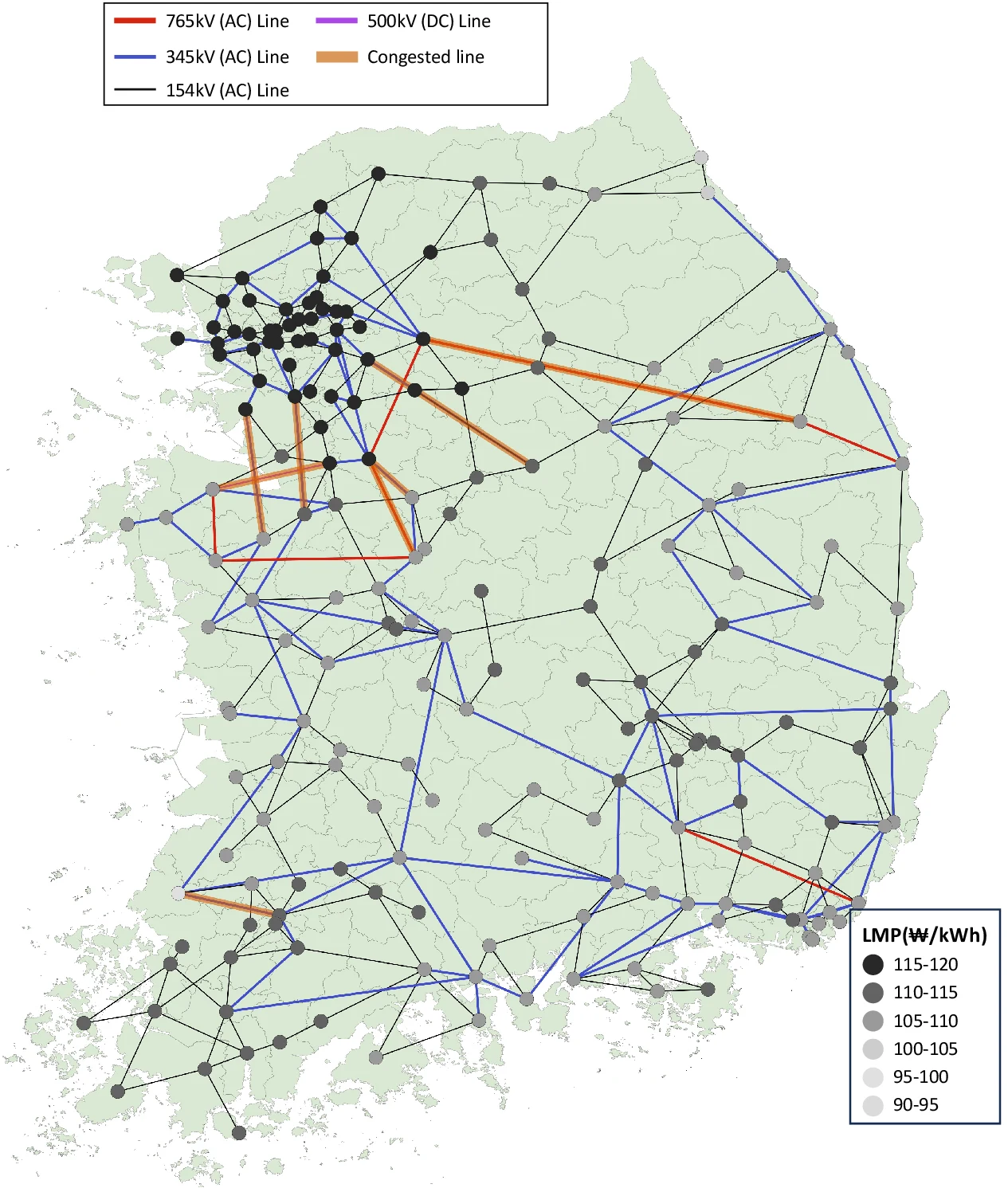
Summer-peak nodal LMP map (reference snapshot).
Replication Assets (Code + Data)
LMP reproduction repository: KPG Platform LMP Repository
Comparison/conversion repository: KPG Platform Converters Repository
Base dataset repository: KPG TestGrid Repository